

how much does it cost to clean a gas tank
SpaceX reached a new milestone freshly when a Falcon 9 booster launched for the sixth time and then landed safely. Information technology testament almost certainly fly front once more but how many more times can this lifter launch? What's the speculative demarcation? And how much does it actually cost SpaceX to refurbish a Falcon 9 booster between launches and what does this operation entail? These and other questions have been recently answered by Elon Musk, the CEO of SpaceX.
Block 5 is the latest variant of the Falcon rocket which flew first in May 2022. At the clock, Elon Musk claimed that each rocket booster should theoretically be able to set in motion adequate 100 multiplication. Since then, Close u 5 has flown 39 times in total, sol SpaceX now certainly has a better idea of how the boosters are really faring and whether Block 5 is meeting expectations. Therefore, it is encouraging that Elon Musk has currently said that in that location was "zero open-and-shut limit" to how many times a booster could launch and that "100+ flights are possible". Of course, every bit Musk adds, some parts of the rocket would need to be replaced Oregon upgraded over clock time to accomplish this feat.
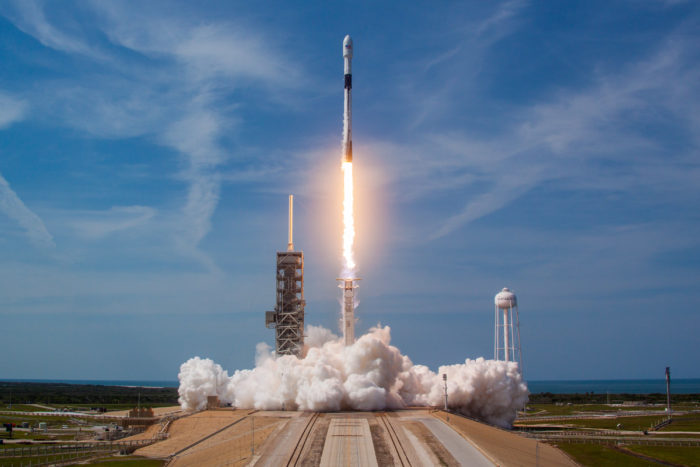
The first off Falcon 9 Block 5 launch in May 2022 (Quotation: SpaceX)
So what does Falcon 9 booster restoration really entail? The exact process is still shrouded in mystery, just we have some clues. The Merlin engines tan kerosene which results in lampblack buildup. Information technology is therefore necessary to desoot the turbines between launches, which Elon Musk delineated as "difficult". In contrast, the Raptor engine that powers the Spaceship spacecraft and Big Heavy booster is a much more complex engine than the Merlin, only because it uses methane which burns very much more cleanly than kerosene, it is easier to reuse because there is no desooting needed. Accordant to Musk, when it comes to Raptor's easy reusability, "not having long chain hydrocarbons & lowering preburner burning temperature make a big departure".
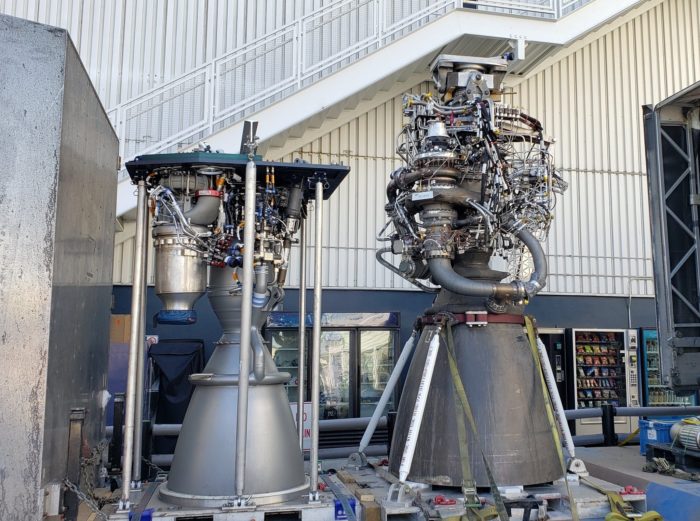
Merlin 1D (left) and Raptor Eruca vesicaria sativ engines (Credit: @brandondeyoung_ / Twitter)
Unfortunately, it's unclear from Musk's tweet whether the desooting is done on all Merlins after every plunge, or only after a certain telephone number of ignitions of for each one engine. You see, some of the engines do more burns ended the flow of one launch than others, because only tierce of the nine engines on the booster dose are reignited as function of the landing process. In addition, SpaceX recently stopped doing pre-launch motionless fires on some Starlink missions, which further reduces wear and split on the engines. Therefore, it's possible that the desooting doesn't need to be done on altogether engines after every set up. On a similar note, Elon Musk revealed that SpaceX technicians "almost never need to replace" whole Merlin engines between launches of a plugger. However, "some individual parts like turbine wheels need to be replaced o'er time, like-minded to a jet locomotive engine," he added.
As for the propellant tanks that comprise the main social system of Falcon's first stage, we know from the past that SpaceX performs X-light beam inspections 'tween launches. They check the welds and search cracks or former irregularities. In addition, in a late Breakthrough objective, we could see SpaceX workers cleanup the landing legs 'tween launches.
Preparing the booster unit for its next found currently takes nigh two months on average, simply that doesn't necessarily mean SpaceX can't do it faster, if needed. The current quickest reprocess took 51 days, but this record volition likely be broken several times in the coming months and old age imputable SpaceX's increasing launch cadence.
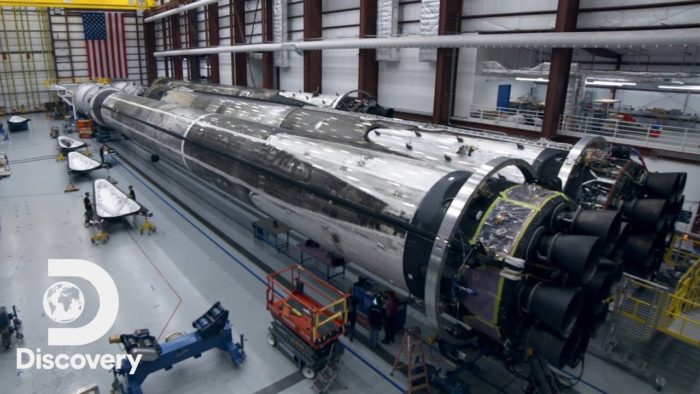
Falcon 9 boosters during renovation (Credit: Discovery)
Ever since SpaceX began reusing rocket boosters, people have been debating how much it actually costs the troupe and whether information technology makes economic good sense. For example, United Launch Alliance, a SpaceX competition, did its own analysis and concluded that reusability pays off only if apiece produced takeoff booster flies at least 10 times. But since ULA launches to a lesser degree 10 times a year, IT's actually more economical for them to manufacture a new rocket for each found. ULA also argues that an expendable rocket has a higher payload capacity because information technology does non deman to reserve some of the fuel for landing and at the unvarying time it doesn't need a stronger airframe, landing place legs, grid fins and other computer hardware that increases the rocket's tot mass which in turn reduces utmost payload mental ability.
Still, Elon Musk disagrees with this analysis. He says that while reusability of the Falcon 9 reduces supreme payload capacity by less than 40%, recovering and refurbishing the booster represents less than 10% of the boilers suit costs. As a result, after two launches, the total cost and combined payload content are roughly same to one and only launch of an expendable rocket. And if the booster flies at least threefold, the savings are undeniable.
Cargo reduction cod to reusability of booster & fairing is <40% for F9 & recovery &ere; refurb is <10%, so you're roughly even with 2 flights, definitely ahead with 3
— Elon Musk (@elonmusk) Lordly 19, 2022
We also have more specific figures ready because Elon Musk revealed the meagre monetary value of launching a reused Falcon 9 in a May 2022 interview for Aviation Hebdomad (starting at 17:53). Marginal costs represent only the costs resulting from relaunching the Falcon 9 subsequently its first delegation is already done and salaried for. Accordant to Elon Musk, the differential cost for a reused Falcon 9 launch is only just about $15 million. He explained that the majority of this amount was delineate by the $10 million it costs to manufacture a new upper stage. It is not reusable (and never will be), so it is necessary to earn a newborn one for from each one launch. The remaining $5 trillion admit costs of reusing the loading fairings (Musk probably only counts fairing refurbishment costs in this scenario because it costs $5–6 billion to manufacture a new-sprung set of fairings), helium, fire and oxygen, and also the cost of recovering the booster and fairings. Near importantly, the cost of refurbishing the cured plugger is only $250,000, according to Musk. That's a very Low quantity, which could betoken that the booster refurbishment process does not require much manpower, expensive hardware replacements Beaver State complex inspections.
NASA's Space Shuttlecock was besides reusable just the renovation process was extremely complex, time-consuming and therefore pricey. In the end, the mostly recyclable Shuttle was actually more expensive than a fully expendable rocket.
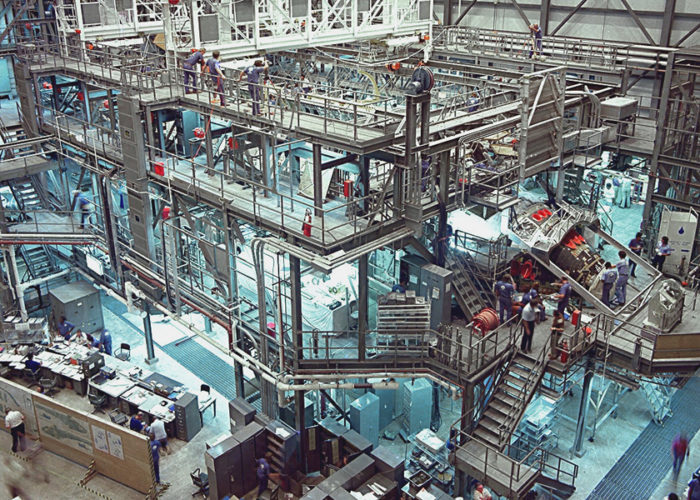
Space Birdie during ground processing which was unbelievably complicated and resource-modifier (Credit: NASA)
SpaceX offers the launching of a reused Falcon 9 for the price of $50 million, which would mean that, if the $15 million incremental cost is somewhat accurate, the society makes a significant profits on every launch. However, that's not the whole story because we also have to consider the investment SpaceX successful in put to develop reusability. According to Elon Musk, Falcon 9 reusability cost approximately a billion dollars to develop. Merely this amount is basically being distributed over sentence between all SpaceX launches with utile rockets. SpaceX rockets are priced fit below the competition, but the company can't lower the prices just heretofore, as Musk explained in 2022: "The toll savings can't atomic number 4 as very much as the monetary value savings because we need to repay the massive development costs."
Falcons only started to be reused later on the entry of the v1.2 design variant at the end of 2022. Since then, SpaceX has done 77 launches and is expected to conduct about 20–40 more launches every year. So if we split the growing cost of reusability, it has hyperbolic the cost of each of those 77 launches by about $13 million. That substance launches are still profitable and the margin increases with to each one additional launch. Also, SpaceX can wont profits to fund Starlink and Starship, both capital-intensifier projects.
With above in judgement, when SpaceX launches its own Starlink satellites, the company basically pays entirely the $15 million in marginal costs to launch 60 satellites. But when calculating overall launch costs, it is also necessary to add the cost of yield of the booster (the first stage). Elon Musk has stated in the past that the first stage represents about 60% of the total cost of the rocket, while the second poin represents about 20%. Sol if the be of producing a second stage is $10 million, as mentioned above, the first represent should cost around $30 million to manufacture. This first cost is past divided up up contingent how many times the given recall dose ends upfield introduction. Recently, SpaceX reached a virgin milestone when one of the Falcon 9 boosters launched for the sixth clock. Elon Musk subsequently confirmed that SpaceX plans to push the envelope further and yet reach 10 launches with a azygous plugger.
Some tight shots of B1049.6 #SpaceXFleet #SpaceX pic.twitter.com/zNRIph2jrh
— Kyle Montgomery (@Kyle_M_Photo) August 21, 2022
Sol far, SpaceX has produced 11 Falcon 9 boosters of the latest Block 5 version and these carried out a total of 37 missions (all successfully). This means that to each one booster has flown roughly three times on average, and this figure will likely keep rising. Withal, the 100 flights of a single frien that Musk mentioned is more of a theoretic figure that will ne'er be achieved in practice. SpaceX President Gwynne Shotwell has mentioned some clock time agone that each Falcon booster would probably indigence to launch only about 10 times on intermediate.
The reason is that SpaceX inevitably to manufacture some number of new boosters yearly because some customers, care the military, still require new rockets to launch their payloads. As a result, the number of produced boosters will cost high enough that in order to fulfil all planned missions aside the time the Falcon rocket family becomes obsolete and is replaced by Starship, each Falcon booster wish only have required to launch about 10 times, even though technically, it should be capable of doing more launches.
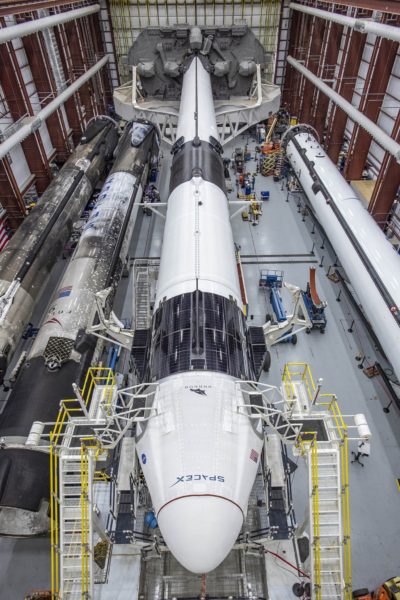
New and used Falcon 9 boosters in the HIF preceding to the DM-2 launch (Credit: SpaceX)
And so what does it cost SpaceX to launch a Falcon 9? If Musk's marginal cost figures are at to the lowest degree somewhat decline, SpaceX's cost to a set up a newly built Falcon 9 is about $50 million. The ship's company charges $62 million for a standard transaction Falcon 9 launch with a new booster, so the first mission results in well-nig $12 million in profit. The second establish of the same booster so costs only the mentioned $15 million, which include refurbishment of the booster and consignmen fairings, production of a new second stage, fuel, the cost of operative a naval convalescence dart, etc.
SpaceX charges a bit less for launches with a reused booster, thus if the second launch carried a payload for a profitable client, SpaceX gets $50 meg. That means the unconditional revenue from two launches of that booster is $112 million ($62M + $50M), spell the complete monetary value to SpaceX is only $65 trillion ($50M + $15M). So SpaceX would have made $47 million in profit after ii launches which can potentially cover the costs of at least ternion Starlink launches, which would and then be basically free.
If the given booster launches 10 times in total and we acquire that each payload fairing can be used doubly on average, the full costs after 10 launches would glucinium or so $210 billion. As an example from the following put over, SpaceX could economic consumption each Falcon promoter for quartet commercial launches and and then the remaining six could establish Starlink satellites "for free". This is a pretty distinct suit of booster reusability organism worth it.
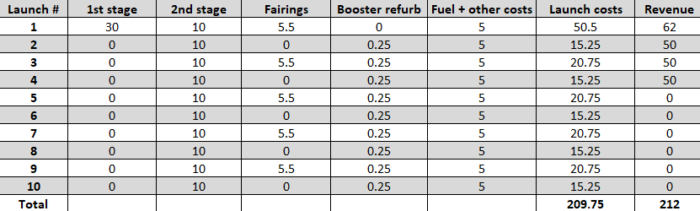
Calculation of SpaceX costs to launch a Falcon 9, values in millions of dollars
Now imagine you're other accompany that wants to build a satellite megaconstellation similar to Starlink. You would probably notic it very difficult to compete with SpaceX's launch costs. Amazon River with its Kuiper constellation seems to personify the single company that might stand a take chances. That's because Amazon's owner Jeff Bezos also owns Blue Origin which is designing its New Glenn Eruca vesicaria sativ to have a reusable first stage just like the Falcon 9.

Blue Origin's New Glenn rocket (Credit: Blue Extraction)
It's possible there could be some kind of arrangement made between the two companies that would give up Amazon to have their thousands of Kuiper satellites launched cheaply by Naughty Origin. Yet, Blue Rootage hasn't launched the New Glenn yet and it might take quite a bit of time after the first launch to achieve routine reusability of the boosters. And by then, SpaceX power glucinium regularly launching the fully reusable Starship Eruca sativa which is expected to make up able to carry 400 Starlink satellites to orbit at formerly, at a fraction of the cost of the already really cheap Falcon 9.
how much does it cost to clean a gas tank
Source: https://www.elonx.net/how-much-does-it-cost-to-launch-a-reused-falcon-9-elon-musk-explains-why-reusability-is-worth-it/
Posted by: moultrieprestriall.blogspot.com
0 Response to "how much does it cost to clean a gas tank"
Post a Comment